
Study Notes
The Danger Zone
How good poker hands turn into expensive mistakes—and how to plan your bets before the pot gets away from you.
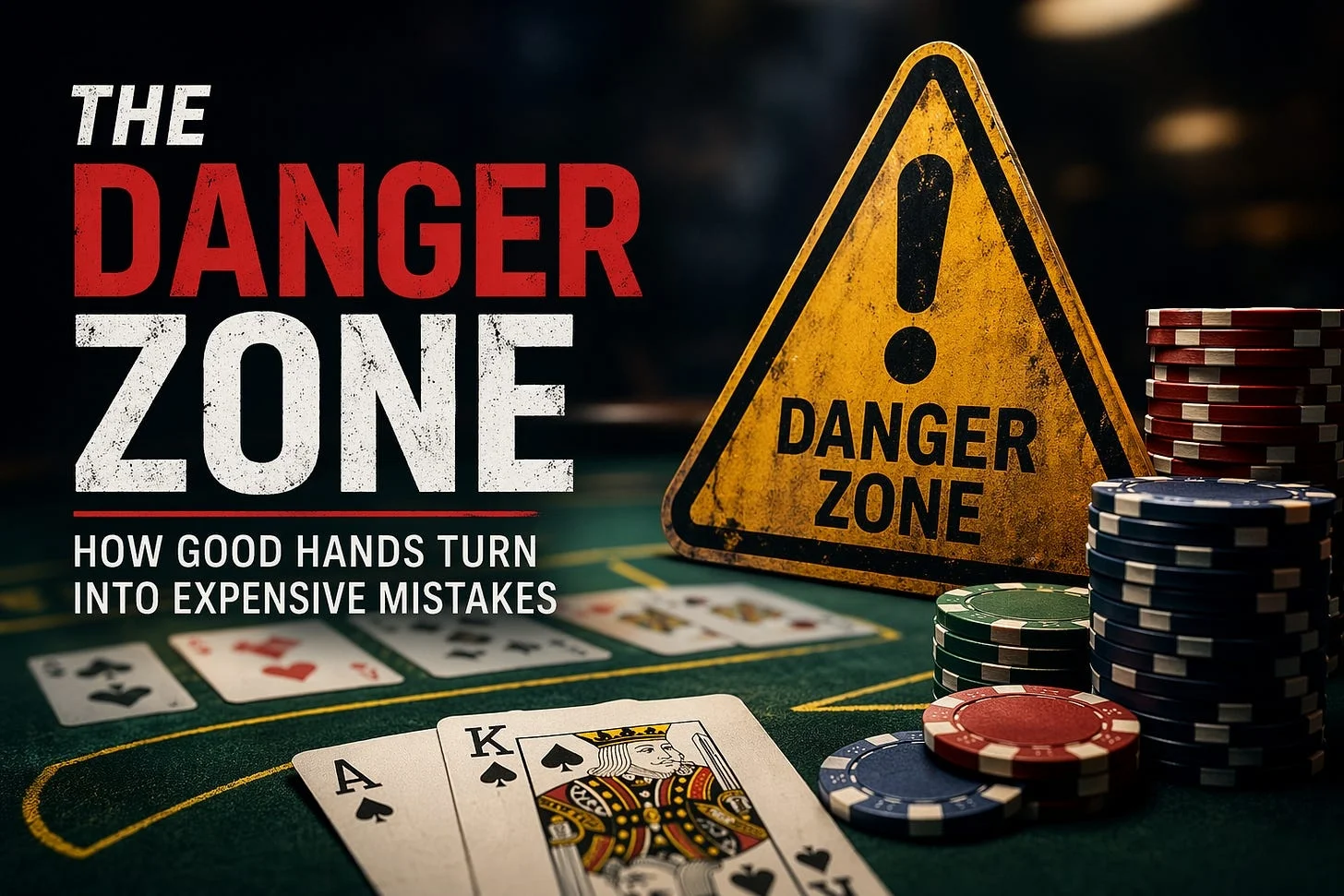
There’s a messy middle area in poker that deserves more attention.
Not the premium hands that basically play themselves.
Not the obvious trash you can fold without a second thought.
This middle ground is what I’ve started calling the Danger Zone — the spot where good hands quietly become expensive mistakes.
Pocket Jacks.
Ace-King on a 10-9-5 flop.
Top pair with a decent kicker on a draw-heavy board.
These hands appear constantly in live games. They aren’t disasters, and they aren’t automatic winners. They’re just good enough to continue with — and that’s precisely what makes them dangerous.
This is where many players lose money without realizing it. Not through wild bluffs or hero calls, but through a series of small decisions that allow the pot to grow beyond what the hand can support.
A Useful Concept
One idea from recent study sessions stands out for its practical value:
Not every good hand is meant to build a big pot.
The concept is simple in theory. At the table, though, when chips are moving and the hand feels reasonably strong, it’s easy to overlook.
That oversight is where the Danger Zone often appears — not in blatant errors, but in subtle ones.
The Third Category
Many players sort hands into two basic groups: strong or weak.
That approach works in clear spots, but poker rarely stays that clean. There’s a third category that creates most of the problems: marginal hands.
These hands aren’t strong enough to stack off with comfortably, yet not weak enough to abandon right away. Because they feel playable, they encourage continued investment. They invite pots to grow in situations where they probably shouldn’t.
That middle ground is the Danger Zone.
Good hands in complicated situations.
A Better Question to Ask
Instead of labeling a hand as simply good or bad, a more useful approach is to ask:
What is this hand trying to accomplish?
A marginal hand typically doesn’t need to win a large pot. It doesn’t require heavy protection, domination, or dramatic heroics. Its main goal is usually simpler: reach showdown efficiently, realize its equity, and avoid unnecessary risk.
This shift in perspective helps clarify decisions in spots that used to feel murky.
A Common Pattern
One situation repeats frequently in live games.
A player flops top pair on a somewhat coordinated board and immediately shifts into protection mode. Concerned about being outdrawn, they increase aggression to “secure” the hand. The result is often a pot that has grown much larger than the hand can profitably handle.
This isn’t usually a gap in technical knowledge.
It’s an issue of instinct and pot management.
A Frequent Spot
Consider this common live-game scenario:
You raise preflop with Ace-King and get one caller.
The flop comes 10-9-5 rainbow.
The standard continuation bet is common here, and it’s not inherently wrong. But it’s worth pausing to consider whether betting is the best option in every case.
A practical question in this spot is:
What happens if they raise?
Checking can be the more disciplined play when the board and ranges favor restraint. Position, stack depth, bet size, and the opponent matter; discomfort alone does not decide the action.
The Value of Pot Control
Developing better restraint in these situations is a valuable skill.
Pot control used to come across as overly cautious. In practice, it functions as effective risk management.
As the pot grows, the cost of being wrong goes up.
Managing pot size helps limit exposure in marginal spots.
Where the Danger Zone Appears Most Clearly
The river is often where marginal hands become most expensive.
By that point, chips, time, and decision momentum have already been invested. This can make it harder to evaluate the hand objectively, especially when it started strong on earlier streets.
Strength at the start of a hand doesn’t guarantee strength at the end.
Boards evolve, ranges shift, and situations change.
The Danger Zone isn’t only about the specific cards held. It’s about recognizing when the overall situation no longer supports continued aggression.
A Practical Mental Check
One straightforward question can help navigate these spots:
If I bet and they raise, am I happy?
If the answer is yes, make sure that confidence is supported by the board, ranges, and stack sizes.
If the answer is no, pause and give the bet a clear purpose. Some profitable value bets and bluffs still fold to a raise.
This is a planning question, not a rule to check every hand that cannot continue against a raise. The goal is to understand the next decision before building the pot.
Refining the Approach
Improving in this area doesn’t require a complete strategy overhaul. It comes down to small, consistent adjustments:
- Calling more selectively
- Betting with clearer purpose
- Folding sooner when the action tells a consistent story
- Keeping pots at a size the hand can handle
These changes are rarely dramatic on their own, but they add up over time.
Staying Out of the Danger Zone
Long-term success in poker comes from disciplined refinement rather than dramatic breakthroughs. It means identifying small inefficiencies and tightening them gradually.
The goal is straightforward:
Win the small and medium pots
Avoid large unnecessary losses
Make slightly better decisions in marginal situations
When that process is followed consistently, the math tends to take care of the rest.
That’s the work — staying out of the Danger Zone, one decision at a time.
—ShaggyGreen